

Office Market Research

Research, analyis and commentary on office markets.

The Apocalypse Model, Rerun
PDF

The Apocalypse Model, Rerun

Summary. In February 2026 the American Economic Review published “Work from Home and the Office Real Estate Apocalypse” by Arpit Gupta, Vrinda Mittal and Stijn Van Nieuwerburgh, whose headline numbers, New York office values down 46.7 percent from 2019 and $556.8 billion of value destroyed across the United States, have been widely quoted. This article reruns the paper’s model from the authors’ replication package. The model’s one unobservable setting, the persistence parameter p, is estimated from a single year’s return on three REIT stocks and gives the remote-work state an expected length of eight years. Rerun with one change, Manhattan’s recorded leasing and rents for 2024 through mid-2026 in place of the remote-work state’s assumptions, the same model puts the New York office stock at 78 percent of its 2019 value at the end of 2026, against the paper’s 47 percent. The paper’s own tenant evidence suggests why: tenants cut their space once, at the first lease expiry, by an amount set by their office policy, rather than bleeding demand for as many years as a stock price implies. Three appendices show how little it takes to move the estimate of p, give the model’s leasing and rent inputs by market state, and compare the result with the New York City Department of Finance’s valuation of every office building in Manhattan. Sixteen pages.

Suggested citation: Colacino, Michael. “The Apocalypse Model, Rerun.” Haiku Partners, October 2026.

office leasingremote workmarket analysisManhattanresearch
Office Demand and Remote Work: Analysis and Projection
PDF

Office Demand and Remote Work: Analysis and Projection

Summary. Written in April 2020, at the start of the pandemic, this paper asks whether the shift to work from home will translate into a significant reduction in office demand. Its thesis is that the translation of employees’ desire for flexibility and CFOs’ desire for cost savings into lower demand is limited by the fundamental nature of employee demographics and of office leasing. High-status employees have had the flexibility to work from home since the 1990s and are unlikely to give up their workspace permanently. Administrative and clerical staff were largely moved to remote work in the late 1990s and early 2000s and occupy the least space, so shifting them has the smallest effect on demand. That leaves professional staff as the main opportunity for demand reduction, which materializes only if they surrender their workplaces or adopt hot-desking and hoteling, against which many countervailing forces operate. The paper projects office demand under these constraints.

office leasingremote workmarket analysis
Serial Probability Recursion as a Method to Assess Manhattan Rental Rate Turning Points
PDF

Serial Probability Recursion as a Method to Assess Manhattan Rental Rate Turning Points

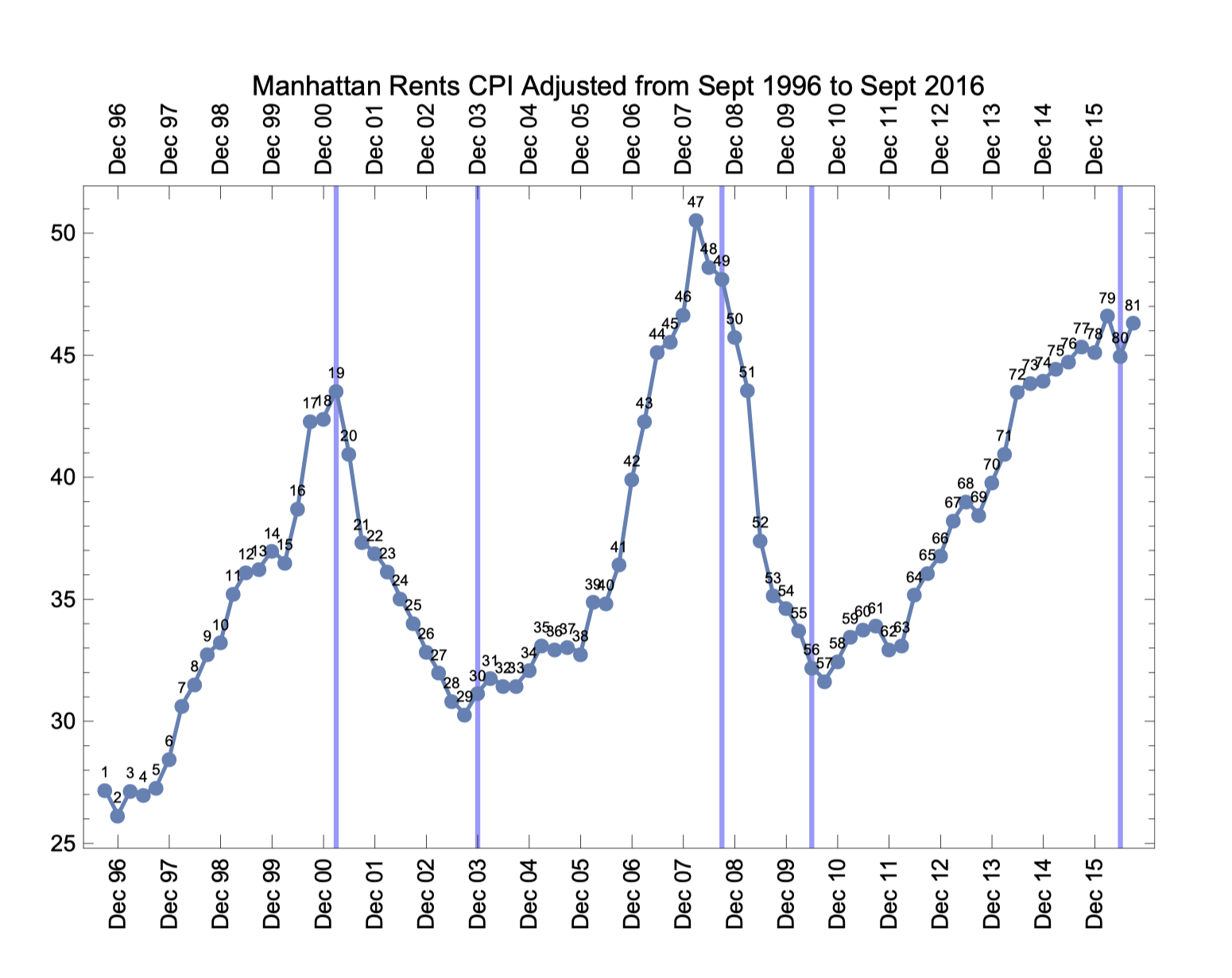
Abstract. The paper applies an algorithm for turning point prediction originally developed by Neftçi (for assessment of the business cycle) to the New York City commercial office market. Using office employment data as an indicator, the algorithm attempts to predict peaks and troughs in asking rents (as provided by CoStar), and is tested against rental data from 1996 to 2016. The algorithm provides a continuous probabilistic assessment of the likelihood of a turning point, which can be monitored (as new data becomes available) to assess tenant strategies in an evolving market. Three different methods of computing the algorithm’s transition probabilities are examined, two from the literature and one unique to the paper. These approaches are compared using diagnostic measures from the literature. Although the algorithm does not provide significant (multiple-quarter) “look ahead” power, its results are good at calling the turning point in real time, thereby providing strategic guidance at the ambiguous and essential instant of a market change.

Working paper, September 2017. Suggested citation: Colacino, Michael. “Serial Probability Recursion as a Method to Assess Manhattan Rental Rate Turning Points.” Working paper, 2017.

statisticsmarket analysisManhattan
Productivity and Remote Work
PDF

Productivity and Remote Work

Summary. The debate over productivity and work from home has become polarized since the pandemic, and much of the business press asserts that remote work has been proved to raise productivity. This paper argues that the research to date does not come close to proving that claim, and that a careful reading of the academic literature together with the actions corporations are actually taking shows a different pattern. It sorts the available evidence into three categories (self-assessment surveys such as the Survey of Working Arrangements and Attitudes, measured-output studies, and corporate decisions), examines what each can and cannot establish, and then traces how the academic findings are presented or distorted in the business and popular press. October 2023.

remote workproductivityresearch