
Serial Probability Recursion as a Method to Assess Manhattan Rental Rate Turning Points
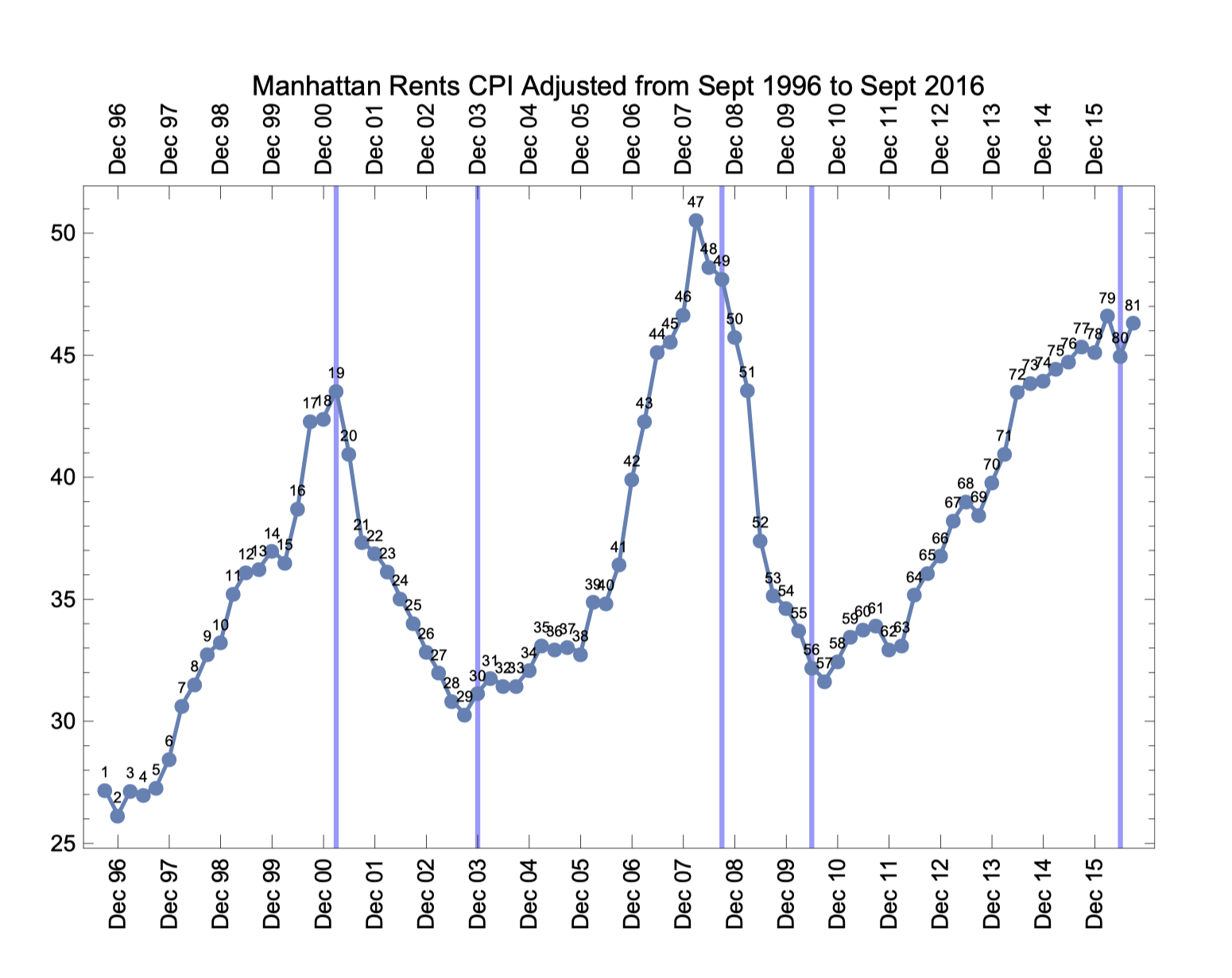
Applying serial probability recursion to predict turning points in Manhattan rental rate trends.
Abstract. The paper applies an algorithm for turning point prediction originally developed by Neftçi (for assessment of the business cycle) to the New York City commercial office market. Using office employment data as an indicator, the algorithm attempts to predict peaks and troughs in asking rents (as provided by CoStar), and is tested against rental data from 1996 to 2016. The algorithm provides a continuous probabilistic assessment of the likelihood of a turning point, which can be monitored (as new data becomes available) to assess tenant strategies in an evolving market. Three different methods of computing the algorithm’s transition probabilities are examined, two from the literature and one unique to the paper. These approaches are compared using diagnostic measures from the literature. Although the algorithm does not provide significant (multiple-quarter) “look ahead” power, its results are good at calling the turning point in real time, thereby providing strategic guidance at the ambiguous and essential instant of a market change.
Working paper, September 2017. Suggested citation: Colacino, Michael. “Serial Probability Recursion as a Method to Assess Manhattan Rental Rate Turning Points.” Working paper, 2017.